
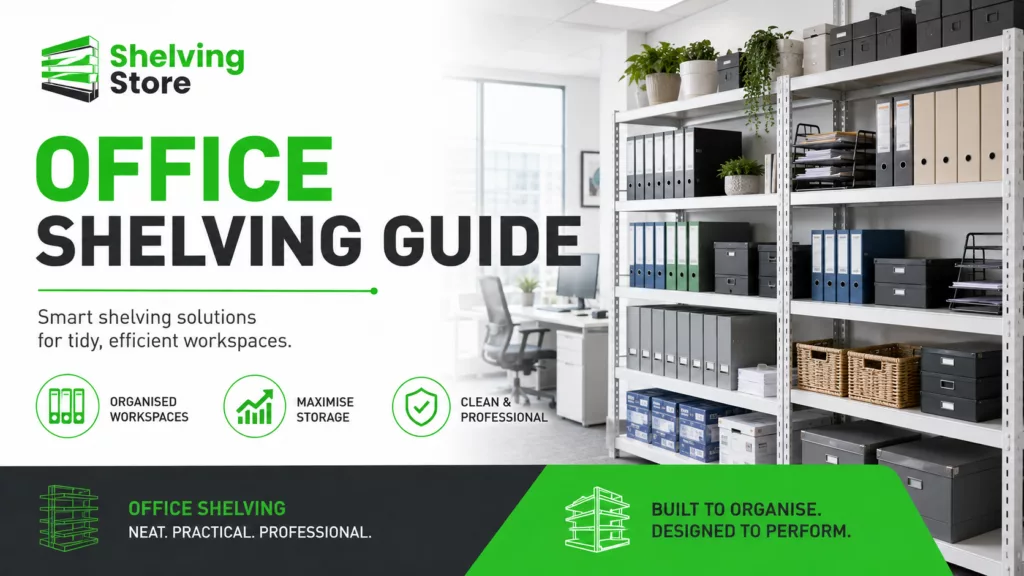
Office Shelving Guide
Good office shelving keeps files, supplies and equipment organised while making the best use of available space. The right system can reduce clutter, improve access to information and create a more professional working environment.
This guide covers office shelving types, file and archive storage, shelf depth, load capacity and practical ways to plan for future growth.
Identify What the Office Needs to Store
Begin by listing the items that need a permanent storage location. Offices often store files, archive boxes, stationery, supplies, equipment and reference material.
- Lever-arch files and folders
- Archive boxes
- Stationery and printer supplies
- Books and manuals
- Marketing material
- Small office equipment
- Consumables and cleaning supplies
Separate active items from archive material. Frequently used files should remain close to the people who need them, while older records can move to a dedicated archive area.
Measure the Office and Storage Areas
Measure the available wall length, ceiling height and usable depth. Check doors, windows, plug points, skirting, air-conditioning units and office furniture before selecting a shelving size.
In working offices, allow enough room for chairs, walkways and cupboard doors. Deep shelving can hold larger boxes, but it may make a small room feel crowded.
- Measure file and archive-box dimensions
- Allow access space in front of each unit
- Keep emergency routes clear
- Check ceiling and light clearances
- Consider whether shelving will be visible to customers
Choose a Suitable Office Shelving System
Nut and Bolt Shelving
Nut and bolt shelving is a practical and economical choice for archives, storerooms and general office supplies. Adjustable shelf positions make it easier to accommodate different file and box heights.
Econo Shelving
Econo shelving works well for general storage where a simple steel frame and board shelves provide enough capacity. It can be suitable for office supplies, boxes and back-room storage.
Wall Band Shelving
Wall band shelving uses vertical slotted uprights and brackets fixed to a suitable wall. It keeps the floor open and can suit offices, meeting rooms and compact storage areas.
Heavy-Duty Shelving
Heavy-duty shelving is useful for large archive volumes, bulk consumables or equipment that exceeds the capacity of standard office shelving.
Select the Right Shelf Depth
The shelf should support files and boxes fully without excessive overhang. Measure your standard archive boxes and filing products before ordering.
- Shallow shelves for books, stationery and smaller files
- Medium-depth shelves for lever-arch files and general office boxes
- Deeper shelves for large archive boxes and bulk supplies
Avoid using very deep shelves for small files. Items may become difficult to see and wasted space can build up behind the front row.
Calculate the Required Load Capacity
Paper is heavy. A shelf filled with files or archive boxes can carry more weight than it appears to. Estimate the total weight across one shelf and select a system with a comfortable safety margin.
- Weigh or estimate one full file or archive box.
- Multiply by the number that will fit on one shelf.
- Allow extra capacity for future additions.
- Check both the per-shelf and complete-unit ratings.
Archive Tip: Do not place all heavy archive material on upper levels. Keeping dense boxes lower improves stability and reduces lifting risk.
Create an Efficient Filing Layout
Arrange files in a way that matches how the office works. Group records by department, year, client or document type, then label shelves clearly.
- Place active records at a comfortable height
- Use consistent labels on boxes and shelves
- Keep confidential records in controlled areas
- Create a clear archive-retention system
- Leave some free space in each section for new files
A simple location code can make retrieval easier. For example, label shelving bays A, B and C, then number each shelf level.
Balance Appearance and Practicality
Shelving in a customer-facing office should match the surrounding environment. Powder-coated steel offers a neat, durable finish, while galvanised shelving provides a practical option for storerooms and archive areas.
Open shelving keeps items visible and accessible. However, use labelled boxes or matching containers where a tidier appearance is important.
Make Use of Vertical Space
Taller shelving can increase storage capacity without using more floor area. Store frequently used files between waist and shoulder height, and place lighter or less frequently used items on upper levels.
Make sure staff can reach upper shelves safely. Do not encourage climbing on shelving; provide suitable access equipment where required.
Plan for Growth and Record Retention
Office storage needs often increase gradually. Leave space for new files and choose adjustable or modular shelving that can expand later.
- Allow spare shelf capacity
- Use starter and add-on bays for longer archive rows
- Review retention periods to avoid unnecessary storage
- Keep current and archived records separate
Office Shelving Checklist
- I have measured the room and standard file sizes.
- The shelf depth suits files and archive boxes.
- The load capacity allows for the weight of paper records.
- Frequently used items will remain easy to reach.
- The finish suits the office or storeroom.
- Confidential records can be controlled appropriately.
- The system allows room for future files.
- Walkways and access routes remain clear.
Related product ranges: Powder-coated shelving · Econo shelving · Wall band shelving · Galvanised shelving · Browse all shelving
Related buying guides: How to Choose Shelving · Garage Shelving Guide · Retail Shelving Guide
Need Better Office Storage?
Explore office shelving, archive storage and wall-mounted shelving solutions from Shelving Store.
View Related Products