
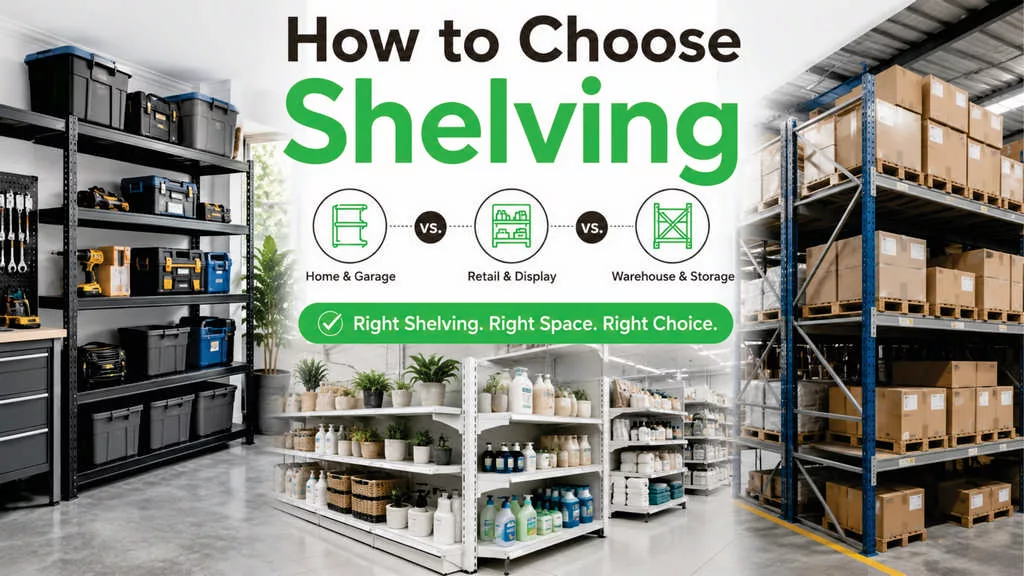
NEW Shelving Buyers Guide
Choosing the right shelving or racking system can make a major difference to how efficiently you use your available space. The correct system helps you organise stock, improve access, reduce clutter and create a safer storage area. However, with so many sizes, materials and load capacities available, it is not always easy to know where to start.
Some shelving systems work best for files, boxes and household items. Others are designed for retail displays, workshop equipment or heavy warehouse stock. Therefore, the best option depends on what you need to store, how much each item weighs and how you use the space.
This guide explains the main factors to consider before buying shelving or racking. It also covers the most common storage systems and helps you choose an option that meets both your current and future needs.
Start by Understanding Your Storage Requirements
Before comparing different shelving products, take time to assess your storage requirements. A clear plan can help you avoid buying shelves that are too small, too weak or unsuitable for the available space.
Start by asking the following questions:
- What items will you store?
- How much does each item weigh?
- How many items do you need to store?
- How often will you need access to them?
- Will your storage needs increase in future?
- Is the shelving for a home, office, shop, workshop or warehouse?
- Do you need open shelves, enclosed storage or product displays?
The type of item matters because different products create different storage challenges. For example, archive boxes need wide, evenly spaced shelves. Small parts may need dividers or plastic storage bins. Long or bulky products may require deeper shelves. Meanwhile, retail merchandise must remain visible and easy for customers to reach.
Therefore, do not choose shelving based only on price or appearance. First, make sure the system suits its intended purpose.
Measure the Available Space
Accurate measurements are essential when planning a shelving or racking installation.
Measure the height, width and depth of the available area. In addition, check for doors, windows, electrical points, columns, pipes and other obstructions. These features may reduce the usable space or affect where you can position the shelving.
Remember to leave enough room around the shelving for safe movement. Although deeper shelves provide more storage capacity, they also reduce aisle space. As a result, the deepest option is not always the most practical choice.
When measuring, consider the following:
Ceiling Height
Taller shelving makes better use of vertical space. However, you must still allow enough clearance below ceilings, lights and other fittings.
You should also consider how users will reach the upper shelves. Frequently used products should remain at a comfortable height, while lighter or less frequently used stock can go higher.
Shelf Width
Wider shelves can store larger items and reduce the number of upright frames required. However, shelf width may affect load capacity. Longer shelves often need stronger supports when carrying heavy products.
Therefore, check the rated shelf capacity rather than assuming that every shelf can carry the same weight.
Shelf Depth
The shelf should support the stored item properly without allowing it to extend too far over the front or back.
Shallow shelving works well for files, small containers, retail products and smaller boxes. In contrast, deeper shelving is often better for bulky stock, tools, large containers and workshop equipment.
Understand Shelf Load Capacity
Load capacity is one of the most important factors when choosing shelving or racking.
Every shelf has a maximum recommended load. Manufacturers often express this as a Uniformly Distributed Load, commonly shortened to UDL.
A UDL rating assumes that the weight spreads evenly across the complete shelf. For example, a shelf rated for a specific load may support that weight when boxes cover the shelf evenly. However, placing one very heavy object in the centre creates a concentrated load and places greater stress on the shelf.
Therefore, always consider both the total weight and the way you will position the items.
To estimate the required capacity:
- Identify the heaviest products that you plan to store.
- Estimate how many will fit on one shelf.
- Calculate their combined weight.
- Add extra capacity for future changes and a reasonable safety margin.
Avoid regularly loading shelves to their absolute maximum. Instead, choose a system with more capacity than you currently require. This approach provides greater flexibility and reduces the risk of overloading.
Buying Tip: Choose a shelving system with more capacity than you currently need. The additional margin gives you greater flexibility and reduces the risk of accidental overloading.
You must also consider the total load carried by the complete shelving bay. Even when each shelf remains within its limit, the combined weight may exceed the capacity of the full unit.
Choose Between Shelving and Racking
Although people often use the words shelving and racking interchangeably, the systems generally serve different purposes.
Shelving usually stores smaller items that users load and retrieve by hand. Common examples include boxes, tools, files, containers, spare parts and retail products.
Racking generally supports larger, heavier or bulkier stock. Depending on the system, workers may load products manually or use material-handling equipment.
The correct choice depends mainly on the size and weight of the stored products.
Choose shelving when:
- Items are small or medium-sized
- Staff will load products by hand
- You need several shelf levels
- Storage density and organisation are important
- You need a cost-effective general storage solution
Choose racking when:
- Products are large, heavy or bulky
- Shelving does not provide enough load capacity
- You need wider storage levels
- You are planning a warehouse or industrial storage area
- You require a system that can expand into longer storage rows
In some cases, a combination provides the best solution. For example, a warehouse may use racking for bulk stock and smaller shelving units for spare parts or order-picking areas.
Main Types of Shelving and Racking
Different systems suit different applications. Therefore, understanding the main options can make your buying decision easier.
Nut and Bolt Shelving
Nut and bolt shelving is one of the most practical and economical general storage options.
As the name suggests, nuts and bolts connect the shelves to the upright frames. This creates a strong structure while allowing users to position shelves at different heights during assembly.
Nut and bolt shelving works well for:
- Storerooms
- Offices
- Archive storage
- Garages
- Workshops
- Stock rooms
- Small parts
- Household storage
The modular design also makes it possible to place several units next to one another. As a result, businesses can create organised shelving rows without investing in a larger racking system.
Galvanised shelving provides a practical finish for general storage environments. Meanwhile, powder-coated shelving offers a neat appearance and a heavy-duty, durable finish.
Nut and bolt shelving may take longer to assemble than some boltless systems. However, it remains a reliable and cost-effective choice for many applications.
Econo Shelving
Econo shelving provides an affordable storage solution for homes, garages, offices, small businesses and general storerooms.
These units commonly use strong steel frames with timber-based shelf decks. Different load options may also be available, allowing buyers to select a unit that suits lighter household goods or heavier commercial stock.
Econo shelving works well for:
- Storage boxes
- Household goods
- Garage equipment
- Office supplies
- Packaged stock
- Tools and accessories
Because it focuses on practical storage at an affordable price, Econo shelving can be a good starting point for customers who do not need a specialised industrial system.
However, always check the shelf capacity before ordering. A light-duty unit may look similar to a heavier model, but the two products may support very different loads.
Heavy-Duty Shelving
Heavy-duty shelving fills the gap between standard shelving and larger racking systems.
It usually provides wider shelves, deeper storage levels and greater load capacity. Therefore, it works well for products that are too heavy or bulky for conventional shelving but do not require full warehouse racking.
Common applications include:
- Garages
- Workshops
- Factories
- Commercial storerooms
- Maintenance areas
- Industrial storage
- Larger boxes and equipment
Different decking materials may be available, including steel or timber-based options. Each material offers different benefits.
Steel decking is durable, easy to clean and suitable for demanding environments. Timber decking can provide a more economical surface for cartons, containers and general stock.
Heavy-duty shelving often uses starter and add-on bays. A starter bay includes the frames needed to stand independently. An add-on bay shares a frame with the previous unit. Consequently, add-on bays can reduce the cost of creating longer shelving rows.
Light-Duty and Medium-Duty Racking
Light-duty and medium-duty racking provides a stronger storage solution for warehouses, factories, workshops and commercial storage areas.
Despite the name, this type of racking can support significantly heavier loads than many standard shelving systems. It can also provide wider storage levels and greater flexibility.
A typical racking system includes:
- Upright frames
- Horizontal beams
- Shelf decking
The beam size, shelf width and decking type all affect the final load capacity.
Racking works well for:
- Large cartons
- Heavy stock
- Industrial components
- Workshop equipment
- Bulk storage
- Warehouse order-picking areas
In addition, businesses can customise many racking systems according to the required height, width, depth and number of levels.
Racking may cost more than standard shelving. However, the additional capacity and flexibility can make it the better long-term investment for heavier stock.
Gondola Shelving
Gondola shelving, also known as supermarket shelving or retail shelving, is designed for displaying products in shops and other customer-facing environments.
It provides adjustable shelves and can support a wide range of retail accessories. Therefore, businesses can change the display as product ranges grow or seasonal requirements change.
Single-sided gondola shelving usually stands against a wall. Double-sided units create freestanding aisles in the centre of a shop.
Gondola shelving works well for:
- Supermarkets
- Hardware stores
- Pharmacies
- Spaza shops
- Convenience stores
- Parts retailers
- General retail stores
Accessories may include pegboard panels, peg hooks, baskets, dividers and additional shelves. As a result, retailers can display many product types on one flexible system.
When planning a retail layout, remember to allow enough aisle space. Customers should be able to browse comfortably without blocking access to other shelves.
Wall Band Shelving
Wall band shelving uses slotted uprights fixed to a suitable wall. Brackets attach to the uprights and support steel or timber shelves.
Because the system uses wall space, it keeps the floor open and can make smaller rooms feel less cluttered.
Wall band shelving works well for:
- Offices
- Homes
- Shops
- Workshops
- Garages
- Display areas
- Small storerooms
Users can adjust the shelf heights as storage needs change. In addition, the open design keeps products visible and easy to reach.
However, correct installation is essential. The wall, fixings and installation method must support the expected load. Therefore, use suitable fixings and seek professional advice when necessary.
Select the Right Shelving Material
The shelving material affects durability, appearance, maintenance and price.
Galvanised Steel
Galvanised steel provides a practical and durable finish for many storage environments.
It works particularly well in:
- Warehouses
- Garages
- Workshops
- Storerooms
- Industrial areas
The galvanised surface helps protect the steel and requires relatively little maintenance. In addition, its practical appearance suits areas where function matters more than decoration.
Powder-Coated Steel
Powder-coated steel provides a neat appearance together with a heavy-duty, durable finish.
It works well in:
- Offices
- Retail areas
- Stock rooms
- Customer-facing spaces
- Commercial storage areas
Powder coating also creates a smooth finish that is easy to clean. Furthermore, colour options can help shelving match an existing workspace or retail environment.
Timber or Board Decking
Timber-based decking can provide an economical shelf surface for general storage and heavier shelving systems.
It works well for:
- Boxes
- Containers
- Tools
- Packaged stock
- Garage storage
However, timber may require more care in damp or dirty environments. Therefore, consider the surrounding conditions before choosing a decking material.
Consider Shelf Adjustability
Storage requirements rarely remain the same forever. Products change, stock levels increase and businesses introduce new packaging sizes.
For this reason, adjustable shelving offers an important advantage.
Adjustable shelf levels allow you to:
- Reduce wasted vertical space
- Store products of different heights
- Reconfigure the system later
- Add extra shelves when required
- Improve storage efficiency
Before ordering, check how easily the shelf positions can change. Some systems use bolts, while others use clip-in brackets or beam connections.
A system that takes slightly longer to assemble may still provide excellent long-term flexibility.
Plan for Future Expansion
Many buyers focus only on their current storage needs. However, future expansion should form part of the buying decision.
A modular system allows you to add extra bays, shelves or accessories later. Therefore, you can expand gradually instead of replacing the complete installation.
Starter and add-on configurations are especially useful for creating longer rows.
A starter bay normally includes two complete upright frames. An add-on bay then connects to the starter bay and shares one of its frames.
This design can:
- Reduce the cost of longer shelving rows
- Create a more consistent layout
- Use available space efficiently
- Make future expansion easier
Before buying, consider where an additional unit could fit in future. Leaving some expansion space may prevent costly layout changes later.
Planning Tip: Leave space at the end of a shelving row where possible. This makes it easier to add another bay later without redesigning the entire layout.
Choose Shelving for the Application
The location and intended use should influence your final decision.
Garage Shelving
Garage shelving must handle tools, containers, equipment and household items.
Choose shelves with enough depth for storage boxes and enough capacity for heavier equipment. Galvanised steel and heavy-duty shelving often provide practical options.
In addition, place heavy items on the lower shelves. This improves stability and makes the products easier to lift.
Office Shelving
Office shelving usually stores files, archive boxes, stationery and documents.
Measure standard file and archive box sizes before choosing the shelf depth. Adjustable shelves provide extra flexibility, while powder-coated finishes can create a cleaner appearance.
Retail Shelving
Retail shelving must organise products while keeping them visible.
Gondola shelving provides a flexible solution because retailers can combine shelves, peg hooks and other accessories. However, the layout must also support customer movement and product accessibility.
Warehouse Shelving and Racking
Warehouse storage must balance capacity, accessibility and safety.
Consider product dimensions, stock movement, load capacity and aisle width. In addition, plan how staff will load and retrieve products.
For heavier or wider stock, racking may offer a better solution than standard shelving.
Workshop Shelving
Workshop storage must keep tools, parts and equipment organised.
Heavy-duty shelving works well for larger items, while shelving with containers or dividers can organise small components.
A combination of shelving, pegboards and plastic storage bins may create the most efficient workspace.
Avoid These Common Buying Mistakes
Many shelving problems start during the planning stage. Fortunately, you can avoid most of them with accurate measurements and realistic load calculations.
Important: Do not estimate shelf loads by appearance alone. Several light boxes can create a substantial combined load when placed on one shelf.
Common mistakes include:
- Buying shelves before measuring the room
- Choosing shelves based only on price
- Ignoring the maximum shelf capacity
- Confusing evenly distributed loads with concentrated loads
- Selecting shelves that are too shallow
- Blocking doors, windows or electrical points
- Failing to leave enough aisle space
- Storing the heaviest products on upper shelves
- Overlooking future expansion
- Buying a system that cannot accept extra shelves or accessories
Another common mistake involves estimating the load by guesswork. Individual boxes may feel light, but a complete shelf of boxes can become very heavy.
Therefore, calculate the expected load whenever possible.
Shelving Safety Tips
Correct use is just as important as choosing the right system.
Follow these basic safety guidelines:
- Place shelving on a firm, level surface.
- Assemble the system according to the supplied instructions.
- Check that all nuts, bolts, beams and brackets are secure.
- Do not exceed the recommended shelf or unit capacity.
- Spread loads evenly across each shelf.
- Store heavier products on lower levels.
- Avoid climbing on shelving.
- Keep aisles clear.
- Inspect the system regularly for damage.
- Secure shelving where the application or environment requires it.
In addition, train staff to report damaged shelves, frames or beams. Early repairs can prevent larger problems and reduce safety risks.
A Simple Shelving Selection Checklist
Before placing your order, confirm the following:
- I have measured the available height, width and depth.
- I know the approximate weight stored on each shelf.
- I have selected a suitable shelf depth.
- The shelving suits the intended environment.
- There is enough aisle and access space.
- The system can support future expansion.
- The finish suits the application.
- The shelf levels provide enough adjustability.
- I understand the stated load capacity.
- I have considered delivery, assembly and installation.
If you can answer each point confidently, you are more likely to choose a suitable system the first time.
Choosing the Right Shelving or Racking System
The best shelving system is not always the largest, strongest or most expensive option. Instead, it is the system that matches your products, available space, required capacity and daily operations.
For general storage, nut and bolt shelving provides a practical and economical solution. Econo shelving offers affordable storage for homes, garages and businesses. Meanwhile, heavy-duty shelving provides more strength for larger products and demanding environments.
For retail displays, gondola shelving offers flexibility and easy product access. Wall band shelving makes effective use of wall space. Finally, racking provides the additional width and capacity required for heavier commercial and warehouse stock.
Careful planning will help you create a storage area that remains organised, accessible and safe. Therefore, measure accurately, calculate your expected loads and consider future growth before placing your order.
Need Help Choosing the Right Storage System?
Shelving Store supplies shelving, racking and storage products for homes, offices, shops, workshops, warehouses and commercial applications throughout South Africa.
You can also use StorageFlow to plan your shelving layout and prepare a bill of quantities before ordering.
Explore our range or contact the Shelving Store team for help choosing a system that suits your space, load requirements and future plans.
Explore Our Shelving & Racking Range